
Vacuum Tumbling, Salt Curing or Mixing | Guide
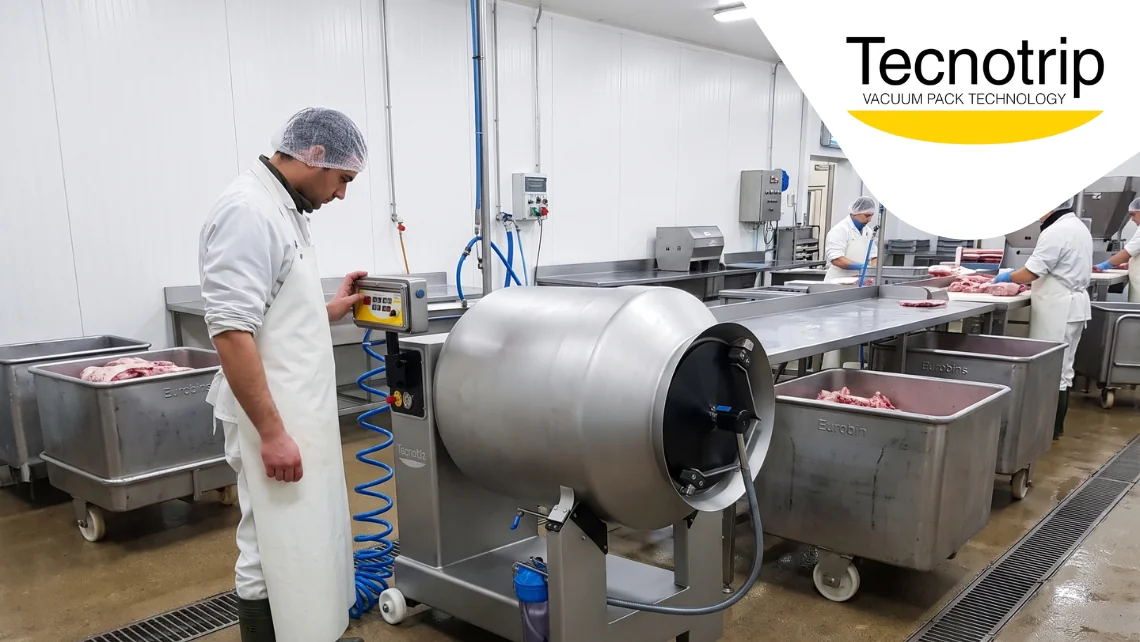
In a food production workshop, a meat processing plant or a ready-meal kitchen, three terms often come up: salt curing, tumbling and mixing. All three involve salt, spices and meat. And all three are frequently confused when choosing a machine.
That confusion can be costly in two ways. Some producers salt entire batches by hand without realising that a vacuum tumbler can distribute salt more evenly and with less handling. Others buy a meat tumbler to mix sausage meat, pasta with sauce or a prepared salad, only to discover that a machine designed for tumbling does not mix ingredients into a homogeneous blend.
This guide explains the three processes separately: what each does, which products it is suitable for and which machine you need. We use two real product ranges as examples: SAP vacuum tumblers, manufactured by Tecnotrip, and Vakona vacuum tumbler-mixers, made by our German manufacturing partner. You can explore the full range on our vacuum tumbler page.
Three processes that are often confused
Before looking at the equipment, it is important to understand the basic differences:
- Salt curing: salt gradually penetrates the meat through diffusion, with time and refrigeration, to preserve it and prepare it for curing. The process can take place while the meat is resting or inside a vacuum tumbler.
- Tumbling: a machine works whole or cut pieces of meat so they absorb brine or marinade and bind together during cooking.
- Mixing: a machine combines different ingredients (minced meat, pasta with sauce, prepared salads, ready meals, etc.) into a uniform mixture.
Three different processes with different objectives. And, as you will see, they do not all require the same machine.
Salt curing: distributing salt evenly
Salt curing is the oldest of the three processes. Traditionally, the product is covered with dry salt or immersed in brine, then left to rest under refrigeration. The salt slowly penetrates from the outside in, draws out moisture and prepares the product for drying and maturation.
This is the basis for products such as dry-cured ham, cured pork shoulder, cecina (air-dried beef), cured pork loin, salt cod and anchovies.
What you need to know
- The aim is preservation and maturation, not increased juiciness. Salt curing removes moisture; tumbling, on the other hand, helps the product retain liquid.
- Uniformity is essential. If one piece absorbs more salt than another, the batch will be inconsistent: some pieces will be too salty, while others may not preserve properly.
- Drying and maturation still take time. No machine can replace the resting period needed in a curing chamber.
What about a vacuum tumbler?
This is where a vacuum tumbler makes a difference. As the drum rotates, it distributes salt or brine evenly across all the pieces, while the vacuum helps the salt penetrate more effectively. The result is more uniform salting than in stacked or vat-based processes, with less manual handling.
It works with both dry salt and brine, as well as marinades such as those used for pork loin before curing.
Product range example: SAP vacuum tumblers (Tecnotrip)
Manufactured by Tecnotrip, these tumblers are available in 70, 200, 470, 800 and 1,200-litre capacities (the SAP-70 is a tabletop model) and are designed for salt curing and tumbling.
Their standard digital controller (with up to 30 programmes) stores a cycle for each product, including operating and pause times. This means the same tumbler can salt products in the morning and tumble cooked-meat products in the afternoon. Variable speed control is optional.
Tumbling: working the meat to improve absorption
A meat tumbler uses a rotating stainless-steel drum with paddles that lift and drop the meat repeatedly.
This mechanical action achieves three things:
- It relaxes the muscle fibres, helping the meat absorb brine more effectively.
- It extracts binding proteins at the surface. This sticky layer helps the cooked product slice cleanly without falling apart.
- It distributes liquid throughout the batch, giving all the pieces a consistent result.
When the tumbler operates under vacuum, the brine penetrates more effectively, foaming is reduced and the product becomes more compact, without air pockets that can appear as holes during slicing.
This process is essential for cooked ham, cooked pork shoulder, turkey breast, cooked pork loin and marinated chicken or pork.
For large cuts, the brine is usually injected first, followed by tumbling to distribute and retain it.
Product range example: SAP vacuum tumblers (Tecnotrip)
The same SAP model used for salt curing also performs tumbling: the programme changes, not the machine. With the appropriate tumbling cycle (running time, pauses and vacuum), it is suitable for cooked meats and marinated products.
Mixing: combining ingredients into a uniform mixture
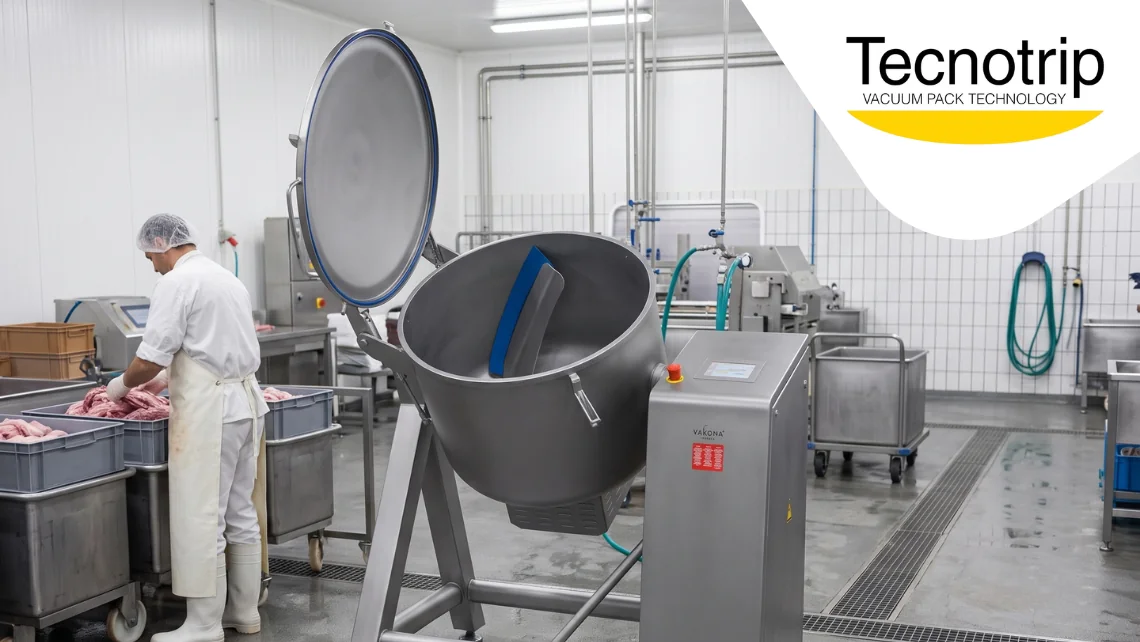
Mixing is a different process. Instead of working a piece of meat to improve absorption, it combines several ingredients until the mixture is homogeneous, with sauce, dressing or spices distributed evenly throughout.
And it is not limited to meat. Mixing is used in many food sectors:
- Meat processing: minced meat for sausages, burgers, meatballs or fillings.
- Ready meals and minimally processed foods: pasta with sauce, rice dishes, stews, Russian salad, bean salads and pasta salads.
- Fish processing: prepared fish products, surimi and fillings.
- Vegetable products: dressed vegetables, prepared vegetable products and fillings.
Rotating a drum is not enough for mixing. You need a tumbler-mixer with paddles that actively combine the ingredients rather than relying solely on tumbling. A meat tumbler moves the mixture around but does not blend it evenly.
Why use vacuum?
Mixing without air prevents bubbles and foam, limits oxidation and produces a more compact product with better colour. In a prepared salad or pasta with sauce, it also helps the sauce coat each ingredient more evenly.
When the starting product is minced, good mixing begins at the mincer: a clean cut, sharp cutting components and chilled ingredients are essential for a good mixture. You can see our MADO mincers in our processing equipment range.
Product range example: Vakona vacuum tumbler-mixers
The Vakona VM range (from 60 litres) combines both functions: it works as a tumbler-mixer and, with the optional tumbling arm, as a vacuum tumbler (also suitable for salt curing).
The Vakona ESK range is refrigerated: it keeps the product cold throughout the cycle, maintaining the cold chain and preventing it from heating up during processing.
It is designed for temperature-sensitive products, such as ready meals and fresh foods.
The Vakona MGH 20 STL is a tabletop tumbler for retail shops.
Comparison: tumbling, salt curing and mixing
| Process | Objective | Products | Machine |
|---|---|---|---|
| Salt curing | Distribute salt to preserve the product and prepare it for curing. | Dry-cured ham, cured shoulder, cecina, pork loin, cod and anchovies. | SAP vacuum tumbler. |
| Tumbling | Improve brine absorption and help meat pieces bind together. | Cooked ham, turkey, cooked pork loin and marinated products. | SAP tumbler or Vakona VM with tumbling arm. |
| Mixing | Combine ingredients into a homogeneous mixture. | Sausages, burgers, ready meals, pasta dishes and salads. | Vakona VM or ESK tumbler-mixer. |
SAP or Vakona: how to choose for your production
Capacities are based on the current price list. As a general guide, the load capacity in kg is approximately half the model’s capacity in litres.
The practical rule is simple:
- Salt curing, cooked meats and marinades: the SAP handles both processes with a separate programme for each.
- Cooked meats and mixed products (sausages, ready meals, salads): a Vakona VM (a mixer with an optional tumbling arm) handles both tasks in a single machine.
- Temperature-sensitive products or products that must remain within the cold chain: choose the refrigerated Vakona ESK.
- Workshops with limited space: consider the tabletop SAP-70 or MGH 20.
Five questions before requesting a quote
- Which products do you make today, and which would you like to make in a year’s time? If you plan to produce mixed products (sausages, ready meals or salads), that changes the machine you need.
- How many kilograms per batch and per day? This determines the drum size. Allow some room for growth.
- Does your product need to remain within the cold chain during processing? If so, refrigeration prevents it from warming up while it is being worked.
- How will you load and unload the machine? On larger models, a hydraulic lifter and electric tilting reduce the operator’s workload.
- How much space do you have? Installation requirements vary significantly between a tabletop model and a 1,200-litre tumbler.
Common mistakes
- Confusing salting with curing. A tumbler makes salting more uniform, but drying and maturation still need time in a curing chamber.
- Trying to mix ingredients in a meat tumbler. The mixture rolls around but does not bind properly.
- Tumbling or mixing products that are too warm. Mechanical action generates heat; starting with a warm product can break the cold chain and compromise quality and safety.
- Extending cycles ‘just in case’. Excessive tumbling makes meat too soft; excessive mixing breaks down the ingredients.
- Forgetting the vacuum. Without vacuum, brine penetration is less effective and the mixture traps air.
Summary
Salt curing, tumbling and mixing are not the same. Salt curing distributes salt to preserve the product and prepare it for curing; a vacuum tumbler such as the SAP makes this more uniform.
Tumbling works whole or cut pieces of meat so they absorb brine and bind together during cooking. The same SAP machine can perform this process using a different programme.
Mixing combines different ingredients (from sausage meat to pasta with sauce or a prepared salad) and requires a tumbler-mixer such as the Vakona VM range. If the product must remain within the cold chain, the refrigerated Vakona ESK is the appropriate option.
Choosing the right machine starts with knowing which of these three processes you need.
Frequently asked questions
Can a meat tumbler mix sausage meat, pasta with sauce or prepared salads?
No. A meat tumbler such as the SAP moves the product around but does not actively blend it, so the mixture will not be homogeneous. For mixing, you need a tumbler-mixer such as the Vakona VM or ESK.
Can I salt cure products in a vacuum tumbler?
Yes. The SAP tumbler is designed for salt curing and tumbling: rotation distributes salt or brine evenly, while vacuum helps it penetrate for more consistent salting. Drying and maturation still take time afterwards.
What is the difference between the SAP tumbler and the Vakona VM?
The SAP is a Tecnotrip-manufactured vacuum tumbler for salt curing and tumbling, with a digital controller as standard. The Vakona VM is a tumbler-mixer: it mixes and, with the optional arm, also tumbles and salt cures.
Need help choosing?
Tell us which products you make, how many kilograms you process per batch and what you would like to add to your range. We will help you decide whether an SAP tumbler for salt curing and tumbling or a Vakona tumbler-mixer is the best fit.
No-obligation advice. → Contact form / Request advice
Reference source: FAO — Meat Processing Technology for Small- to Medium-Scale Producers.
Article by: Jose Luís Sánchez, Co-CEO and Sales Director of Tecnotrip.
Fecha: 01/11/2026
Categorías: News
Explore more articles on our blog
Discover more from the TECNOTRIP Blog and keep up with our latest news and technical insights.

Discover how to carry out preventive maintenance on your vacuum packaging machine and prevent breakdowns. Learn when to check the Teflon tape, change the pump oil, inspect the seals and clean the chamber. Includes a practical checklist and advice from Tecnotrip’s technical service team.
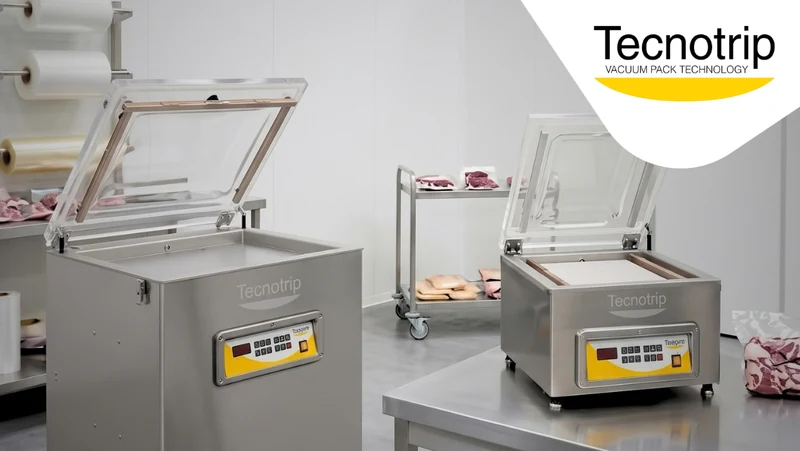
When a workshop or food business considers vacuum packing, the same doubt almost always comes up: chamber or tabletop? tabletop or floor-standing? And behind that doubt there's usually a misunderstanding that costs money.
In the meat industry, every gram counts and every extra day of shelf life turns into margin. And yet, many processing workshops, cutting rooms and butcher's shops keep losing product to poor preservation: meat that oxidises too soon, weight loss through dehydration, and returns that nobody tracks but that quietly eat into the profit.

Discover which packaging technology to apply to 4th and 5th Range —MAP, vacuum, Skin and processing— to extend shelf life, eliminate waste and optimize your line.

Discover the preventive maintenance plan for your vacuum packaging machine: prevent breakdowns, reduce costs and extend machinery life with Tecnotrip's technical service.

Discover how vacuum, MAP and Skin packaging improve the preservation of fresh and cured meat, reduce waste, and optimize your meat facility's efficiency.


