
Chamber Vacuum Sealer: Tabletop or Floor | Guide
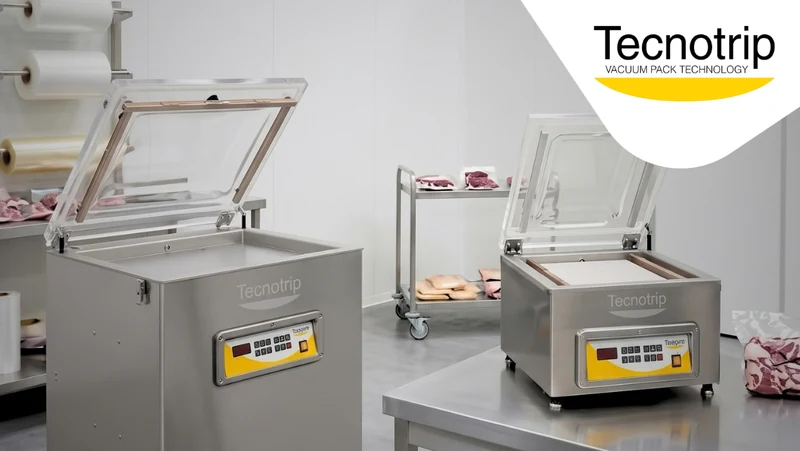
When a workshop or food business considers vacuum packing, the same doubt almost always comes up: chamber or tabletop? tabletop or floor-standing? And behind that doubt there’s usually a misunderstanding that costs money.
Let’s clear it up from the start, because choosing for the wrong reason leads either to falling short on capacity or to paying for a bigger machine than you need. You can see the full range on our vacuum sealers page.
The myth worth clearing up: the tabletop is also a chamber machine
There’s an idea that a “tabletop” sealer is a different, lower-quality machine than a “chamber” one. In Tecnotrip’s case, that’s not true.
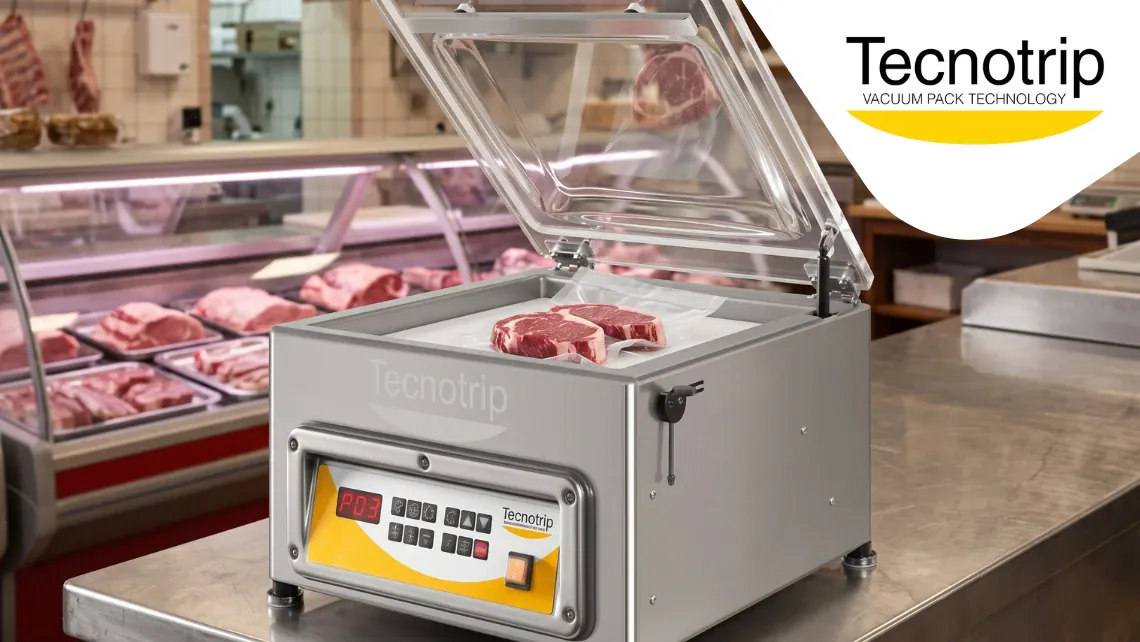
Our entire vacuum range is chamber-based: the product goes inside a chamber that closes, and the vacuum is created throughout it. A tabletop sealer like the EVT-7 has a real chamber (430×440×205 mm), a double sealing bar and even a gas-injection version. It’s a chamber machine; the only thing that changes versus a floor unit is format and size, not the system.
What does that mean in practice?
- The vacuum level a tabletop chamber reaches is the same type as a big one’s. It doesn’t pull “less vacuum” for being small.
- It works with the same flat bags, which are cheaper.
- It can pack liquids and wet products, because the vacuum is created in the chamber, not by suction from the bag.
- Many models support gas injection (modified atmosphere).
That said, not every chamber machine suits every job. What really makes the difference is something else.
So what actually changes between formats?
If the system is the same, the choice comes down to four concrete, measurable variables:
- Chamber size. It determines which pieces and how many bags fit per cycle. It ranges from 300×320 mm on a compact unit to over 1,180 mm long on floor units, or even 916 mm on a tabletop built for long pieces.
- Vacuum pump capacity (m³/h). It doesn’t change the final vacuum or the number of cycles: the pump is sized to the chamber volume. A larger chamber needs more capacity to pull the vacuum in that bigger space within a reasonable time. That’s why the capacity grows with chamber size: from 8 m³/h on the most compact unit to 250-300 m³/h on those with the largest chamber.
- Format: tabletop or floor. A matter of space and ergonomics. The tabletop fits on a countertop; the floor unit is a fixed machine with a larger chamber and pump.
- Cadence: single chamber or double chamber. The double chamber seals one batch while the other is loaded, so the operator doesn’t wait for the cycle. That’s what multiplies packs per shift.
With these four variables, the conversation stops being “chamber or tabletop?” and becomes “which chamber, which pump and which cadence do I need?”.
The tabletop chamber: when it’s the right choice
The tabletop vacuum sealer is the option for workshops, butcher’s shops, producers and low-to-medium volumes with limited space. It fits on a countertop, installs easily and pulls a genuine chamber vacuum.
Some real examples from the Tecnotrip range:
- EVT-14 — chamber 300×320×120 mm, 8 m³/h pump. The compact entry unit.
- EVT-7-C / TD — chamber 430×440×205 mm, 20/21 m³/h pump, double sealing bar, TD version with gas injection.
- EVT-10-C / TD — chamber 530×432×205 mm, 20/21 m³/h pump, with 1 or 2 sealing bars.
- EVT-28 — chamber 916×432×180 mm, two 20/21 m³/h pumps and a double bar: a tabletop built for long pieces.
Note the EVT-28 detail: it shows that “tabletop” doesn’t mean “for small pieces”. You choose the format by space; the chamber, by what you pack.
The floor unit (single chamber): more chamber and more pump
When volume rises or pieces are large, you move to the floor-standing single chamber. Same chamber principle, but with more capacity and larger pumps, sized to pull the vacuum in that bigger chamber. See the detail on the chamber range product sheet.
Real examples from the range:
- EV-15 — chamber 530×432×205 mm, 20/40 m³/h pump. Compact, but already a floor unit.
- EV-13 — chamber 795×535×200 mm, 63/100 m³/h pump, with gas as standard.
- EV-25 — chamber 1118×715×218 mm, 100/150 m³/h pump. Large format.
- EV-29 — chamber 1180×725×220 mm, 100/150 m³/h pump. The maximum single-chamber capacity.
Here we’re no longer talking about a jump in “vacuum quality”, but about how much you pack per cycle.
The double chamber: when the bottleneck is time
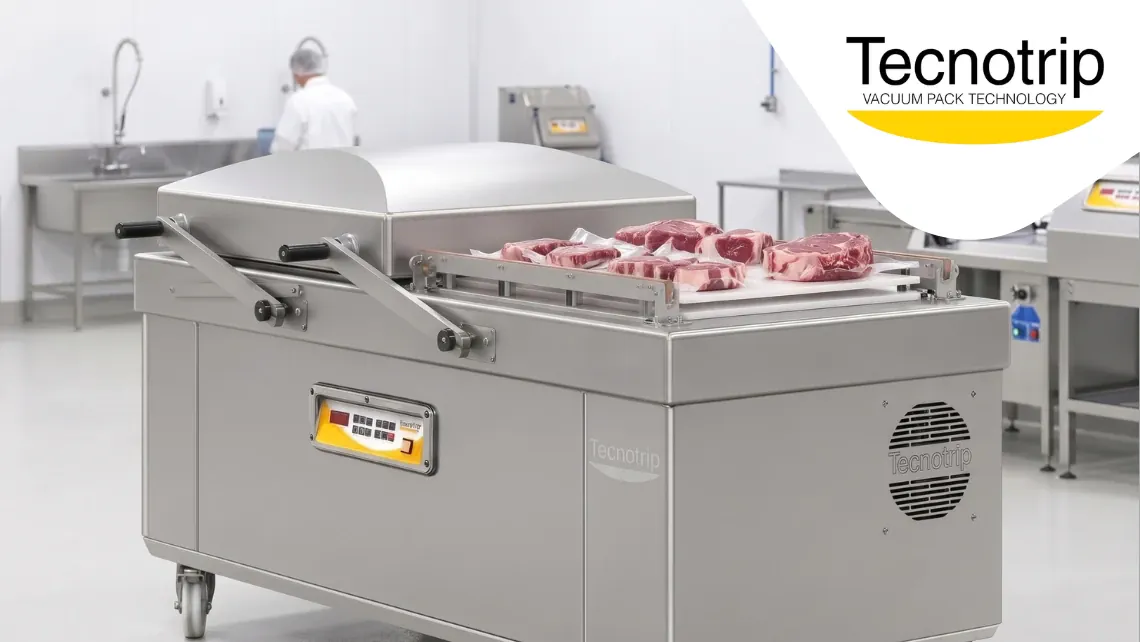
The double chamber is the next step when the problem stops being the chamber and becomes the clock. It has two chambers: while one draws vacuum and seals, the operator is already loading the other. The result is a much higher cadence with nobody waiting for the cycle.
Examples from the range:
- EVD-22 — 2× chamber 640×615×195 mm, 100 m³/h pump. The entry to double chamber.
- EVD-16 — 2× chamber 820×825×225 mm, 150/250 m³/h pump. High cadence.
- EVD-19 — 2× chamber 955×895×250 mm, 250 m³/h pump, with optional automatic lid.
- EVD-19-11 — 2× chamber 1255×925×245 mm, 300 m³/h pump. Large format.
It’s the natural option for meat, fish or ready-meal industries with sustained volume. And above it, the automatic range (loading and unloading without an operator at the chamber) for continuous production.
Comparison by format (real range data)
| Format | Examples | Chamber (mm) | Pump (m³/h) | Ideal for |
|---|---|---|---|---|
| Tabletop (chamber) | EVT-14 · EVT-7 · EVT-10 · EVT-28 | 300×320×120 to 916×432×180 | 8 – 20/21 | Workshop, low-medium volume, little space |
| Floor (single chamber) | EV-15 · EV-13 · EV-25 · EV-29 | 530×432×205 to 1180×725×220 | 20 – 100/150 | Medium-high output, large pieces |
| Double chamber | EVD-22 · EVD-16 · EVD-19 · EVD-19-11 | 2× 640×615×195 to 1255×925×245 | 100 – 300 | High cadence, lines |
The vacuum is chamber-based in all three formats. What changes is chamber size and cadence.
So which one do I need?
Five questions and the decision clears up on its own:
- What pieces do you pack, and how big? This sets the minimum chamber you need.
- How many packs per day, and at peak? Low → tabletop; medium-high → floor; high cadence → double chamber.
- Do you have fixed space or need a countertop machine? This decides between tabletop and floor.
- Do you need gas injection (modified atmosphere)? Available on several models; confirmed by reference.
- Do you expect to grow? If you’re scaling up, it’s worth sizing the pump and cadence with some margin.
None of these questions is about “vacuum quality”, because that’s the same across the range. They’re about capacity. Which is exactly why it’s best to check them with technical advice.
The factor that isn’t on the spec sheet: reliability and service
Choosing a format is the first step. The second, just as important, is who you buy the machine from. A stopped machine isn’t a technical problem: it’s a day you can’t pack and product that deteriorates.
So, beyond the format, it’s worth looking at robust build and longevity —machines that withstand daily use for years—, after-sales service and factory-direct spare parts, and a manufacturer that knows the product and helps you size it right first time. That’s the approach Tecnotrip builds its sealers with in Terrassa: mechanical and electrical reliability, simple maintenance and direct spares, with machines still in service after more than 25 years.
Summary
The right question isn’t “chamber or tabletop?”, because at Tecnotrip the whole vacuum range is chamber-based. The tabletop pulls the same vacuum as the floor unit: what changes is format and capacity. Choose by the size of your pieces, your volume, your space and your cadence —not by a supposed jump in vacuum quality that doesn’t exist— and validate the figures with data.
Frequently asked questions
Does a tabletop vacuum sealer pull less vacuum than a big one?
No. At Tecnotrip the tabletop is a chamber machine, just like the floor unit, and reaches the same type of vacuum. What changes is the chamber size —and the pump, which is sized to that volume—, not the vacuum quality.
Can I pack liquids with a tabletop sealer?
Yes, as long as it’s a chamber machine (like the Tecnotrip range), because the vacuum is created in the chamber and not by suction from the bag. The difference versus a floor unit is capacity, not suitability for liquids.
When do I move up to the double chamber?
When the bottleneck is time, not chamber size. If you need more packs per shift and the operator waits for the cycle, the double chamber loads one chamber while the other seals.
Shall we help you choose?
Tell us what pieces you pack, how much and in what space, and we’ll tell you which format and pump fit —without oversizing or falling short. Advice with no obligation. → Contact form / Request advice
Authority source: UK Food Standards Agency — vacuum packing guidance.
Article signed by: Gemma Ferrer, CEO of Tecnotrip.
Related articles
Fecha: 01/10/2026
Categorías: News
Explore more articles on our blog
Discover more from the TECNOTRIP Blog and keep up with our latest news and technical insights.
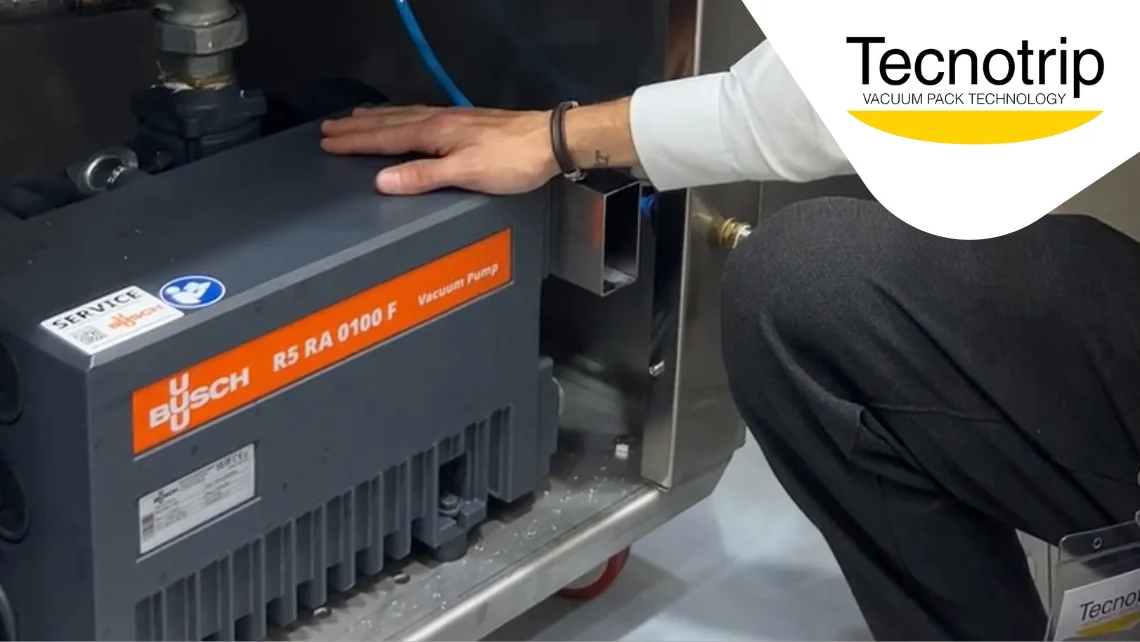
Discover how to carry out preventive maintenance on your vacuum packaging machine and prevent breakdowns. Learn when to check the Teflon tape, change the pump oil, inspect the seals and clean the chamber. Includes a practical checklist and advice from Tecnotrip’s technical service team.
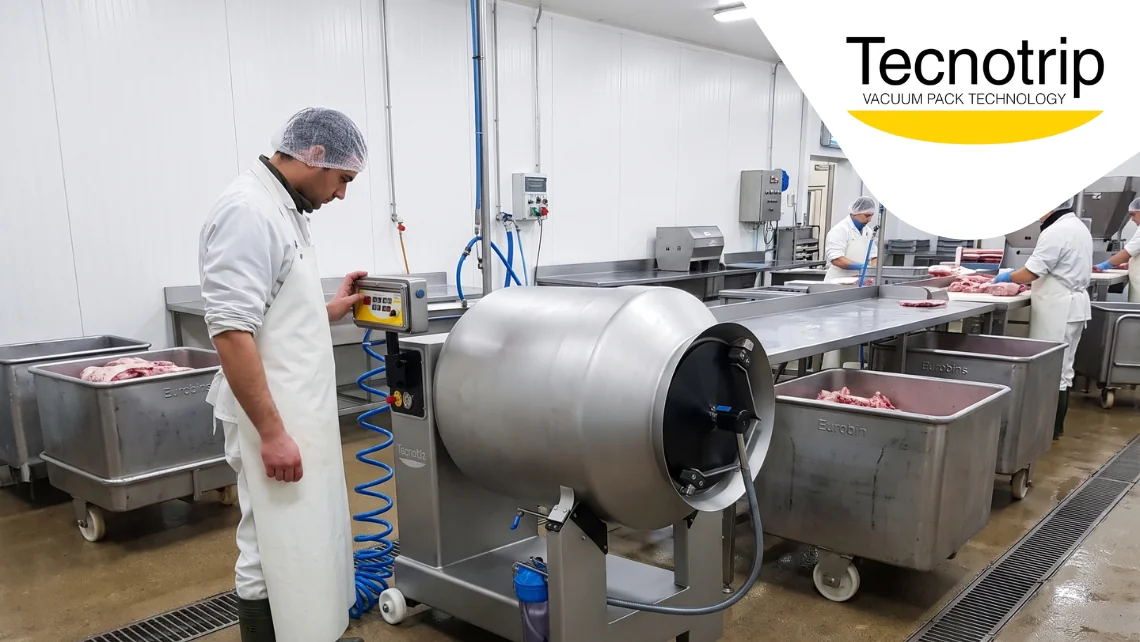
What is the difference between salt curing, tumbling and mixing? Discover how Tecnotrip's SAP vacuum tumblers and Vakona mixers work, their applications in the food industry, and how to choose the right machine for each process.
In the meat industry, every gram counts and every extra day of shelf life turns into margin. And yet, many processing workshops, cutting rooms and butcher's shops keep losing product to poor preservation: meat that oxidises too soon, weight loss through dehydration, and returns that nobody tracks but that quietly eat into the profit.

Discover which packaging technology to apply to 4th and 5th Range —MAP, vacuum, Skin and processing— to extend shelf life, eliminate waste and optimize your line.

Discover the preventive maintenance plan for your vacuum packaging machine: prevent breakdowns, reduce costs and extend machinery life with Tecnotrip's technical service.

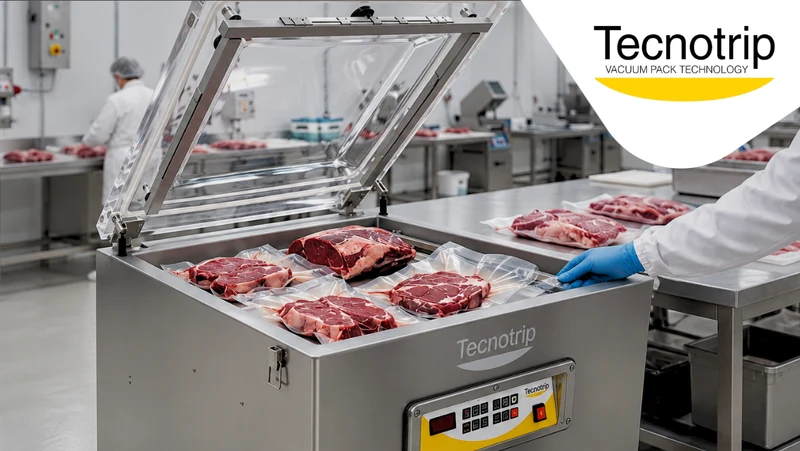
Discover how vacuum, MAP and Skin packaging improve the preservation of fresh and cured meat, reduce waste, and optimize your meat facility's efficiency.


